






CONTACT US
Aluminum Pass Box
Overview:
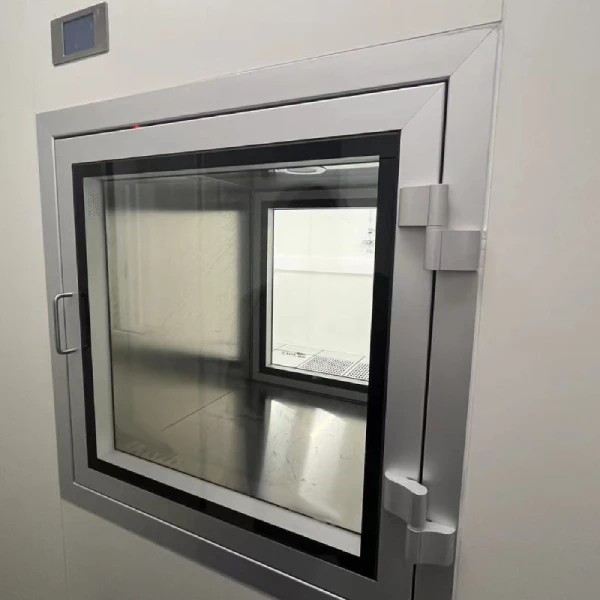
The Cleanroom Aluminum Pass Box is a material transfer device installed between clean and non-clean areas, or between zones of different cleanliness levels. Its primary function is to minimize cleanroom door openings during material transfer, prevent cross-contamination, and maintain the cleanliness classification of different areas. Constructed with an aluminum alloy frame, the pass box offers lightweight design, corrosion resistance, aesthetic appearance, and durability. It is widely used in pharmaceuticals, biological laboratories, electronics manufacturing, food processing, and other industries requiring strictly controlled clean environments.
Hot Tags:
DETAIL:
1. Product Structure
The Aluminum Pass Box consists of the following main components:
| Component | Material/Specification | Function |
|---|---|---|
| Frame/Body | Aluminum alloy profile | Main load-bearing structure, lightweight and sturdy |
| Doors (both sides) | Aluminum + tempered glass window | Double-layer 5mm tempered glass for internal observation- |
| Interlocking Device | Mechanical/Electronic interlock | Prevents both doors from being opened simultaneously- |
| Sealing System | High-efficiency sealing gasket | Ensures airtightness when doors are closed |
| Work Surface | Stainless steel / Non-powered rollers | Smooth, wear-resistant surface for easy material transfer- |
| Control Panel | Intelligent controller (optional) | Controls interlock, UV lamp, buzzer, etc. |
Optional Configurations:
-
UV Sterilization Lamp-
-
HEPA/ULPA High-Efficiency Filters
-
Buzzer/Intercom System
-
Differential Pressure Gauge
-
Electromagnetic Lock Electronic Interlock
-
PAO Test Port
2. Product Features
1. Material Advantage
-
Lightweight yet strong aluminum alloy for easy installation and relocation
-
Anodized surface for enhanced wear and corrosion resistance
-
Aesthetic appearance suitable for cleanroom environments-
2. Interlock Protection
-
Mechanical or electronic interlock ensures both doors cannot be opened simultaneously
-
Effectively prevents cross airflow contamination and maintains cleanroom pressure differential-
-
3. High Sealing Performance
-
Precision manufacturing ensures tight sealing between body and doors
-
Sealing gaskets minimize air leakage-
4. Operational Convenience
-
User-friendly design for simple operation
-
Supports left/right door opening adjustment-
-
Optional non-powered rollers for easy transfer of large items-
5. Customizability
-
Dimensions can be customized to customer requirements
-
Functional modules can be combined as needed
4. Technical Specifications (Standard Model)
| Parameter | Specification |
|---|---|
| External Dimensions (W×D×H) | 760×660×660 mm (customizable)- |
| Internal Dimensions (W×D×H) | 600×600×600 mm (customizable) |
| Frame Material | Aluminum alloy profile |
| Interior Material | Stainless steel / Aluminum alloy |
| Window Material | 5mm tempered glass (double-layer)- |
| Interlock Type | Mechanical / Electronic interlock |
| Power Supply | AC220V, 50Hz (for electronic interlock) |
| Optional Functions | UV lamp, HEPA filter, buzzer, intercom |
5. Product Classification
| Type | Features | Application |
|---|---|---|
| Standard Pass Box | Basic interlock function, no purification | General transfer between clean and non-clean areas |
| Air Shower Pass Box | Built-in fan and HEPA filter with self-cleaning function | Material transfer between high-grade clean areas |
| Self-Cleaning Pass Box | HEPA filtration system for internal air circulation purification | ISO Class 5 and above cleanrooms |
| UV Pass Box | Built-in UV sterilization lamp for surface disinfection | Biopharmaceutical, laboratory aseptic transfer |
6. Working Principle
The working principle of the Aluminum Pass Box can be summarized as High Sealing + Interlocking + Physical Isolation:
Operation Process:
-
Operator on the low-cleanliness side opens the outer door
-
Places materials inside the chamber
-
Closes the outer door (interlock activates)
-
Operator on the high-cleanliness side opens the inner door
-
Removes materials and closes the inner door, completing transfer
Interlock Principle:
-
When one door is opened, the opposite door is automatically locked
-
Ensures air from both zones does not directly communicate
-
Prevents pressure differential disruption and contaminant entry
Purification Principle (Optional):
-
HEPA filter circulates and filters internal air
-
UV lamp irradiates material surfaces for disinfection
-
Ensures cleanliness of both materials and environment during transfer
7. Application Areas
Aluminum Pass Boxes are widely used in the following industries:
1. Pharmaceutical and Drug Manufacturing-
-
Transfer of raw materials, excipients, semi-finished products between different cleanroom grades
-
Complies with GMP standards
-
Supports high-frequency material turnover
2. Biological Laboratories
-
Transfer of biological reagents, cell cultures, microbial specimens
-
UV sterilization function ensures experimental safety
-
Suitable for BSL-2 and above laboratories
3. Electronics and Semiconductor Manufacturing
-
Clean transfer of chips, circuit boards, precision components
-
Reduces dust and static interference on components
-
Improves product yield and production stability
4. Food Processing Industry
-
Transfer of packaging materials, seasonings, semi-finished products
-
Prevents pests, dust, and microorganisms from entering production areas
-
Complies with HACCP food safety standards
5. Medical Facilities
-
Sterile transfer of medical devices and surgical instruments
-
Complies with ISO cleanroom standards
-
Suitable for operating rooms, sterile supply departments
8. Selection Guide
When selecting an Aluminum Pass Box, consider the following factors:
| Factor | Recommendation |
|---|---|
| Material Selection | Stainless steel for high cleanliness requirements; Aluminum for lightweight needs |
| Dimensions | Determine internal space based on maximum material size |
| Interlock Type | Electronic interlock for higher safety; Mechanical interlock for cost-effectiveness |
| Purification Function | UV lamp or HEPA filter required for sterile environments |
| Installation Environment | Verify wall opening dimensions and installation method |
| Certification Requirements | Pharmaceutical industry must comply with GMP standards |
9. Installation & Maintenance
Installation:
-
Cut corresponding opening in the wall
-
Use aluminum profile/galvanized sheet/stainless steel for edge trimming
-
Ensure level installation with proper sealing
Daily Maintenance:
-
Clean internal and external surfaces daily
-
Regularly inspect sealing gasket integrity
-
Test interlock functionality periodically
-
For HEPA filter units, perform regular integrity testing
10. Conclusion
The Cleanroom Aluminum Pass Box is an essential material transfer device in controlled environments. Its combination of lightweight aluminum construction, reliable interlock protection, and customizable features makes it an ideal choice for pharmaceutical, laboratory, electronics, and food industry applications. Proper selection, installation, and maintenance ensure long-term reliable operation and contamination control.
FAQ
- 1 How do electronic interlocks improve operation?
- 2 What installation method is best for sterile applications?
- 3 What sealing gasket maintenance is required?
- 4 What is the proper disinfection procedure for materials?
- 5 Is surface sampling required for pass-through chambers?
- 6 How should pass-through chambers be classified for cleanliness?
- 7 How does the door interlock system work?
- 8 What is the main purpose of a pass-through chamber?
- 9 What are the differences between various Pass Box types?
- 10 How to manage material transfer in sterile environments?
- 11 How to handle weighing processes in hazardous environments?
- 12 What are the differences between various material transfer systems?
1
How do electronic interlocks improve operation?
Electronic interlocks provide audio/visual alerts when doors are left open, prevent accidental damage from forced opening, enable BMS integration, and support access control with user data logging.
2
What installation method is best for sterile applications?
Use fully-welded stainless steel construction with continuous seam welds and smooth radius corners. This eliminates hard-to-clean cracks and crevices where contaminants can accumulate.
3
What sealing gasket maintenance is required?
Inspect EPDM or silicone gaskets for 250% compression when door closed. Replace if hardened, cracked, or loss of elasticity. Clean with 70% alcohol; avoid chlorine or strong acid cleaners that cause corrosion.
4
What is the proper disinfection procedure for materials?
Follow "clean first, then disinfect" - remove outer packaging, wipe with 70% isopropyl alcohol or 0.5% peracetic acid, place with spacing between items, and expose to UV for minimum 15 minutes (30 minutes recommended).
5
Is surface sampling required for pass-through chambers?
Yes. USP 797 requires surface sampling of all classified areas including pass-through chambers. Category 1/2 CSPs require monthly sampling; Category 3 requires weekly sampling and batch-end sampling.
6
How should pass-through chambers be classified for cleanliness?
Assign the ISO classification of the cleaner connected space. For example, if a pass-through connects ISO 8 to ISO 7, classify it as ISO 7. Industry best practice follows the higher standard of the two connected areas.
7
How does the door interlock system work?
The interlock (mechanical or electronic) allows only one door to open at a time. When one door opens, the opposite door automatically locks, creating an airlock that prevents cross-contamination and maintains room pressure differentials.
8
What is the main purpose of a pass-through chamber?
A pass-through chamber is an enclosure installed in a cleanroom wall to facilitate material transfer between areas while minimizing contamination risk. It reduces foot traffic, maintains differential pressure, and prevents unfiltered air exchange through interlocked doors.
9
What are the differences between various Pass Box types?
Material transfer between zones uses specific boxes. A cleanroom Dynamic Pass Box includes interlocked doors and UV lights for active decontamination. For simple transfers, a cleanroom Static PassBox serves as a physical barrier without active air circulation. Highly sensitive materials may require a cleanroom VHP Pass Box which uses vaporized hydrogen peroxide for sterilization. Selection depends on the criticality of the items being transferred between classified areas.
10
How to manage material transfer in sterile environments?
Safe transfer prevents cross-contamination. A cleanroom Pass Box allows small item exchange between zones. For active airflow control, a cleanroom Dynamic Pass Box purges particles during transfer. Sterile applications often require a cleanroom VHP Pass Box using vaporized hydrogen peroxide for thorough decontamination of materials entering isolator systems.
11
How to handle weighing processes in hazardous environments?
Potent compound handling requires containment. A cleanroom Negative Pressure Weighing Room protects operators from exposure. Materials enter through a cleanroom Aluminum Pass Box designed for durability. For non-powered transfer, a cleanroom Static PassBox provides a simple interlocked chamber ensuring safety while handling fine powders within the controlled negative pressure environment setup.
12
What are the differences between various material transfer systems?
Material transfer requires strict protocols to prevent cross-contamination. A standard cleanroom Pass Box suits general non-sterile items, while a cleanroom Dynamic Pass Box includes interlocking mechanisms for higher safety. For personnel hygiene before entry, a cleanroom Air Shower Room removes particulates from clothing. Selecting the right transfer method depends on the specific cleanliness class and workflow requirements within the facility design.