







Automotive Cleanroom Speed-to-Production: Modular Panel Systems That Accelerate EV Battery Plant Construction
Discover how automotive manufacturers use modular cleanroom walls to fast-track EV battery production lines, reduce construction time, and maintain quality standards.
The electric vehicle revolution is rewriting the rules of automotive manufacturing. Battery production, electric motor assembly, and power electronics manufacturing all require controlled environments where contamination management directly impacts product quality and safety. For project managers building these facilities under intense market pressure, Clean Room PUF Sandwich Panels Design, technology offers the construction speed that traditional methods simply cannot match.
Cleanroom Requirements in EV Manufacturing
Electric vehicle battery production demands environmental controls that many traditional automotive plants were never designed to provide. Lithium-ion cell manufacturing requires dry rooms with dew points below -40°C, while motor assembly areas need particle-controlled environments to prevent internal contamination that could cause field failures. cleanroom wall system, must deliver both the environmental performance and the construction speed that EV production timelines demand.
The cleanroom wall panels manufacturers, approach to automotive cleanroom design addresses the unique challenges of battery manufacturing environments. Vapor-tight panel seals, integrated desiccant system connections, and thermal bridge-free construction enable the extreme humidity control that lithium processing requires. These specialized features, when factory-integrated into panel systems, eliminate the field-fabrication risks that compromise performance in conventional construction.
For modular cleanroom system, areas, the emphasis shifts to particle control and static management. Panel surfaces with controlled surface resistivity prevent electrostatic discharge that could damage sensitive power electronics, while smooth, non-shedding finishes maintain ISO Class 7 and 8 conditions required for reliable motor assembly.
Compressed Timelines: The Modular Construction Advantage
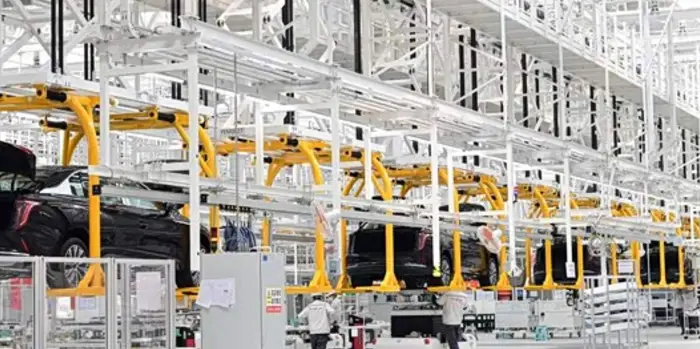
Automotive OEMs are racing to bring EV platforms to market. A delayed production line can cost millions per week in lost vehicle output. Clean Room PUF Sandwich Panels Design, systems compress cleanroom construction from the traditional 4–6 months to 8–12 weeks, enabling manufacturers to meet aggressive vehicle launch schedules that define competitive position in the rapidly evolving EV market.
The speed of cleanroom wall panels cost, deployment stems from fundamental workflow differences. Factory fabrication proceeds in parallel with site preparation, eliminating sequential dependencies. Panel installation rates of 60–100 square meters per day — compared to 10–15 for block construction — enable rapid enclosure of large production areas. This speed extends to services integration, with pre-engineered chase ways and utility panels simplifying mechanical and electrical rough-in.
clean room container, also reduce the weather-related delays that plague conventional construction. Since the majority of fabrication occurs off-site, on-site work is limited to panel assembly and sealing — activities that can proceed in conditions that would stop block-laying, concrete pouring, or coating application. For project managers in regions with challenging climates, this reliability is invaluable.
Scalability for Growing EV Production
EV production volumes are scaling rapidly, and manufacturing facilities must scale with them. cleanroom wall panels cost, provide inherent expandability — production areas can be doubled or reconfigured by adding panel sections without disrupting ongoing manufacturing. This modularity aligns perfectly with the phased capacity expansion strategies that automotive OEMs are pursuing as EV demand grows.
The cleanroom wall system, approach also supports multi-site standardization. Global automotive manufacturers building battery plants across multiple continents benefit from consistent panel specifications that deliver identical environmental performance regardless of local construction labor skill levels. Factory-finished quality eliminates the craftsmanship variability that affects traditional construction across different geographic markets.
For contractors competing in the booming EV facility construction market, expertise in cleanroom wall panels manufacturers, and modular cleanroom system, installation is becoming a key differentiator. The automotive manufacturers who partner with experienced modular contractors are the ones hitting production milestones and capturing market share in the most competitive automotive transition in a century.